Chris Hudson
The Thursday Murder ClubDCI Chris Hudson is the police investigator at the centre of the inquiries into Tony Curran’s murder and Ian Ventham’s death. A conscientious professional with a dryly comic eye for discomfort, he must work among both the residents of Coopers Chase and the members of his own squad, testing how far formal police procedure can take him when important clues lie in old cases, private memories, and evidence outside his control. His investigations give the novel a working detective’s counterpoint to amateur inquiry; his solitary life gives that work a quieter personal cost.
Identity and Introduction
Chris serves as a Detective Chief Inspector in Fairhaven and is responsible for investigating Tony Curran’s murder. When he opens the file, its substantial thickness is made emphatic by the sound it makes when he drops it on a desk. The records show that Curran had a long history of dealings with Kent Police, most of them predating Chris’s arrival in Fairhaven: assault charges, minor drug convictions, dangerous driving, a dangerous dog, possession of an illegal weapon, and lesser offences. The file makes Curran’s criminal past concrete, but it does not by itself explain who killed him.
Chris is not at ease in the sunlit world of Coopers Chase. Driving up its broad approach, he notices the llamas and the lack of visitor parking; on foot, he encounters a village-like community of gardens, flats, gossiping neighbours and a bowls match. The setting is not what he expects from a retirement community, and its pleasant summer atmosphere runs against his own preference for wind and rain, a turned-up overcoat collar, and hibernation. His thought that he has not worn shorts since 1987 gives the contrast a characteristic comic precision: Chris registers the place sharply, but does not pretend to share its easy enjoyment of fine weather.
Investigating Curran and Ventham
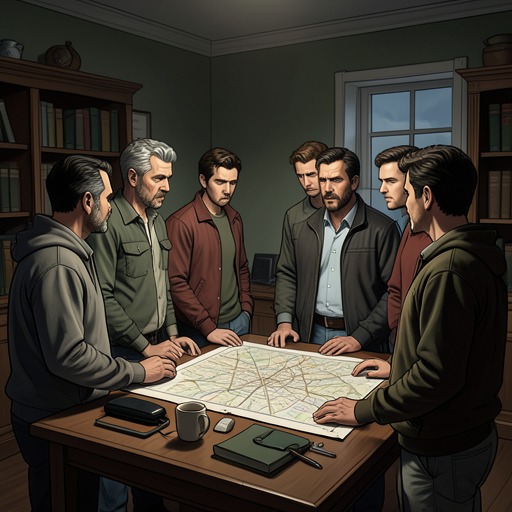
Chris’s work soon connects Curran’s murder to the property deal involving Ian Ventham. In a briefing to his murder squad, he lays out a motive and a timeline: Ventham had told Curran less than two hours before the killing that he was being cut out of a development extending Coopers Chase. The decision would cost Curran a great deal, while Curran’s death had made Ventham more than twelve million pounds. The two men had been seen arguing shortly before Curran returned home. Chris poses the possibilities as questions rather than conclusions: Curran may have threatened Ventham, or Ventham may have arranged for someone to act against his partner. The timing and financial benefit make the connection urgent, but do not yet identify the killer.
Ventham’s own death makes Chris not just the investigator but a witness. He knows he was present and watched Ventham being killed; afterward, in his office, he tries to reconstruct who was there, recalling the Thursday Murder Club and a priest among the people he saw. His immediate analytical question is whether the same person killed both Ventham and Curran. The two cases may share a perpetrator, but Chris’s thoughts show that proximity to a crime is not the same as understanding it: he has seen the death and still has to work out what it means.
At Coopers Chase, his official manner meets the club’s attentive hospitality. While interviewing the residents about Curran, Chris tries to maintain formality, using careful language as he sits hemmed in with a cup of tea too hot and full to drink comfortably. The residents’ kindly attention makes it difficult for him to give way to irritation; Joyce’s offer of lemon drizzle cake further turns a police interview into a social encounter. The awkwardness is comic, but it also marks a practical feature of Chris’s investigation: he has to question people whose manner and setting do not resemble the familiar routines of a station interview room.
Method and Partnerships
Chris’s work with Donna De Freitas combines formal police inquiry with the collection and comparison of details. After learning from the Thursday Murder Club and reviewing information Donna has drawn from the file, he assembles his squad early in the morning and briefs them on Ventham’s financial motive and the disputed timeline. Later, Donna makes a breakthrough by running background checks on Father Matthew Mackie. At Fairhaven Police Station, she and Chris question him in Interview Suite B; Donna recognises the parallel with an earlier interview involving someone pretending to be a nun. The contrast helps show the breadth of her contribution: Chris leads the inquiry, but progress can depend on a colleague noticing what a background check brings to light.
The partnership also has an informal side. After Donna comes to his door late at night with information, the two go over the case and watch television with a bottle of wine. Chris privately wonders whether her ready familiarity is simply how constables from London behave. Later, he imagines inviting her over for dinner, watching something together and talking about Ventham. These moments suggest companionship and a possible intimacy, but they do not establish a relationship. Chris’s interest remains entangled with the case and with his uncertainty about what place, if any, Donna might have in his life.
His interactions with the residents and with Jason Ritchie reveal a capacity to share a moment of play without abandoning his professional role. When Donna raises her phone to photograph Jason beside a dolphin-shaped fountain, Jason begins his familiar refrain and Chris joins in; both men instinctively punch the air as she takes the picture. The scene briefly places the detective inside the spectacle of a boxer’s public identity, rather than simply observing it. Such ease does not erase Chris’s reserve, but it shows that he can meet another person on ground that is not strictly procedural.
Private Life and Isolation
The spaces Chris imagines for himself are notably more settled than the life he has. In the bar at Le Pont Noir, he enjoys the fire and pictures a home with a wife reading nearby while he works through murder notes. He also imagines children asleep upstairs. The scene is explicitly counterfactual: his actual evening means walking home, stopping for chocolate, and returning to a clean flat where nobody cooks and the spare room is unused. He can hear the sea from the window but cannot see it. The details turn his imagined domestic future into a measure of what is missing, without suggesting that he has made a plan to change it.
His isolation appears again in the small absence on his desk: there is no family photograph. He feels a prick of shame when he notices the space and considers putting up a picture of his niece, though he is uncertain whether she is twelve or fourteen and thinks his brother would know. The uncertainty is modest, but telling. Chris is not wholly without family; rather, the thought of his niece exposes how little he is currently keeping track of her life.
The case gives him company and purpose, yet does not wholly answer the personal question. After the warrant for Gianni Gunduz is issued, Chris considers an evening at home with Donna rather than another pub celebration with police colleagues. He wants to watch television, share wine, and talk about Ventham, but also asks himself what the investigation might have missed. Even in the prospect of a private evening, work remains present.
Cyprus and the Limits of Resolution
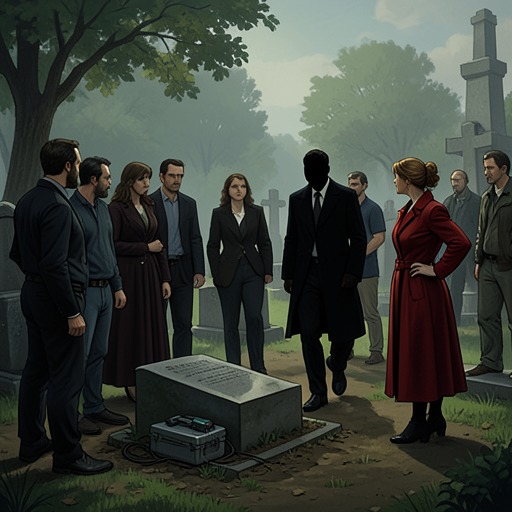
The inquiry eventually takes Chris to Cyprus, where he questions Costas Gunduz with the help of Cypriot detective Joe Kyprianou. Costas, whom Chris guesses to be in his seventies, is notably less forthcoming than another witness Chris has interviewed. The trip also forces a reassessment of the earlier police work: after Chris and Donna return from the graveyard, they discover that Kent Police had never meaningfully investigated Northern Cyprus or Gianni’s family connections. The officers previously sent to Nicosia had not produced a substantial inquiry.
Chris and Donna then revisit passenger lists for arrivals from Larnaca to Heathrow and Gatwick in the week before Curran’s murder. Nearly three thousand names must be considered, most belonging to men and mainly Cypriots. The scale of the search gives the investigation a painstaking, administrative dimension: a promising lead does not immediately become an identity, and the relevant records have to be examined among thousands of possibilities.
The eventual result is an international warrant for Gianni to be arrested for questioning over Curran’s murder. The euros supplied by Steve Georgiou have no fingerprints, but they were exchanged in Northern Cyprus three days before the killing. Chris passes Joe the address of the bureau in case CCTV might help; Joe dismisses that prospect. Chris recognises that the warrant is a good result while remaining unsure whether the Cypriot authorities will pursue Gianni vigorously. He has done what he can, and the next step belongs to them. That qualified ending suits his role: he can build a case, follow evidence across borders, and secure official action, but he cannot guarantee that another jurisdiction will bring the investigation to a final answer.